Friday, June 5, 2009
Natural Pigments: Not what you'd expect
For watercolor, even in the last 30 years, pigments have changed dramatically. For example, I could still buy genuine gamboge, a yellow pigment from a latex-producing tree of Asia, genuine vermilion, a somewhat fugitive red-orange mercuric pigment and genuine Rose Madder as well as true Manganese blue. Now, no one makes Manganese blue as it is a very polluting metallic pigment; vermilion darkens over time, gamboge and madder fade. Madder is still made by the original method by Winsor Newton and is still beautiful. Others imitate it (Rose Madder Genuine by Daniel Smith) but none has the true red color of W/N's special formulation.
Now, Daniel Smith and others make pigments from ground gemstones, but Rublev (naturalpigments.com) makes the old style paints found in Russian icons and the 18th and 19th century Old Master watercolors. I've been testing them out and they are quite interesting, but..not what you'd expect.
I'll put up reviews of the colors, swatches and my findings in blogs to follow.
Sunday, April 5, 2009
It's a BEAUTIFUL BOOK. Click that link to read reviews.
Wednesday, March 11, 2009
Exetazomichanophobia n.
Fear of using search engines. A word I invented to explain the phenomenon of posting a question on a forum to which you can Google the answer but you unaccountably do not, even though you are demonstrably on the Internet and you can use a computer and even a forum.
You heard it here first.
Tuesday, March 10, 2009
Turkish Sock

Using some stashed Kroy sock yarn, I knit up a design of a Turkish sock.
This is designed from Zilboorg's "Fancy Feet" and is done on the fly--a bit tight in the leg but very pretty. As with a lot of Turkish socks, hard to put on but the fit is fine once you get there. And pulling it off is best done by grabbing the heel.
Thursday, March 5, 2009

The winter watercolor class ended 3/4/2009 at the Gibby Center for the Arts in Middletown, DE. In case you don't know, the Gibby is a combination teaching center, studio and gallery on Main Street, next to the venerable Everett Theater. If you've seen "Dead Poet's Society", a film with Robin Williams and Robert Sean Leonard, you've seen the Everett.
Five classes is just enough to get a taste of watercolor--the real learning happens when you repeatedly put BRUSH to PAPER and PAINT. We covered materials, paint characteristics, paper, how to draw if you don't know HOW to draw, washes,, successive layers of glazing, composition, and how to paint faces and figures (Jellybean figures and faces.) But we didn't even have time to get to color harmony, palettes, the chemistry of watercolor painting, and much more. We'll cover more of that in the Spring class, which will focus on getting what you envision from your head to the paper and dealing with the accident-prone nature of watercolor.
I posted a video of how to paint a small painting (ACEO or card-sized) of a watch. Funny, there was a billboard up on 95 in Wilmington some months after I posted this on Youtube, and it looked a LOT like my painting!
Until the Spring class, I'll be posting some lessons here, and eventually we'll move to a better website for the class, but my Blogger is handy right now.
Meanwhile, my class asked for a reading list and here it is:
This is an essential guide to learning about paint characteristics, from pigments to color harmonies. It's also really FUN to read.
This is a great book for learning about color, layers, and consistency of your paint washes and glazes. For some reason, it is out of print (!!!) and I suggest you get a copy even at this price before it becomes scarce.
This is Charles Reid's new book, has all kinds of stuff, from going from photo to painting, and Reid will LOOSEN you up like no other person and help you deal with accidents.
Charles Reid's Watercolor Solutions
FINALLY! A good ALL AROUND BASIC starter textbook with beautiful art.
Watercolor for the Serious Beginner
I'll post more demos, comments and other things in coming weeks, and if any of my STUDENTS want to post some of their work here (I saw some nice stuff from everyone!) email me and we'll do it.
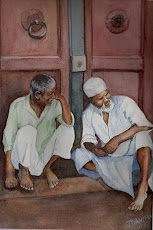
The watercolor is a portrait I did for someone.
Friday, February 13, 2009
Three Women
Tuesday, February 3, 2009
Dragonfly Jacket

Sapphire Dragon Fly Jacket
Original Design by Joanna Daneman
Description:
This sweater is knit from arm to arm, with a front inset panel and color. Eyelash glitter yarn gives a glamour fake-fur effect. Chenille cuffs add textural contrast. The sweater is reversible, depending on how you like the texture of the eyelash yarn and mohair.
Size: 1 size, fits up to extra large.
Materials
· Approx 800 grams (around 2 lbs) La Gran Mohair, Classic Elite Yarns
· The SAME yardage as the mohair you choose of: Novelty Eyelash yarn. (I used a discontinued yarn, Tiber, I believe. It is a thin eyelash with glitter. Fingering weight.
· Small quantity of medium weight (not chunky) chenille for cuffs . If you don’t like chenille, and want a different effect, use a thin satiny or matt ribbon yarn. Want to be REALLY chi-chi? Edge the ribbed collar in I cord or pick up one row and bind off in ribbon for a lovely finish. Naturally, you will need more (thin) ribbon yarn.
· One decorative brooch. I used a Kenneth Jay Lane’s Dragonfly Plique-au Jour pin. This is a good use for that wonderful vintage brooch you have nothing to wear with; choose a yarn to match it. Or check flea markets and antique malls for a costume brooch to match your stash yarn for this project. Of course, then it won’t be a dragonfly jacket, it will be, possibly, Aunt Hilda’s Monkey Brooch jacket.
Colors: Midnight blue mohair, black eyelash with royal blue and gold glitter. Thin taupe and sapphire blue chenille knit doubled (mill end)
Yarn is knit double: mohair and eyelash
Gauge of jacket: 16 st/10 cm about 18 r per 10 cm.
Gauge of cuff: 19 st/10 cm. Can be varied to suit your taste.
Since yarns and novelty knit-ins vary, the best suggestion is to follow the schematic chart measurements, adjusting rows and stitches to suit the gauge you get with your swatch.
This way you can use novelty yarns from the sale bin or your stash.
Needle: I used 10 ½ but I knit loosely. You may need a different size.
Method:
Cast on 40 stitches at cuff end. Knit straight for 3 inches. Then increase 1 stitch each side of right side row until you have 90 stitches (underarm) Cast on 40 more stitches on each side (but you can cast on MORE stitches on back half side for longer back if you want)
Knit until front flap is 28 cm long. Bind off front stitches, continue neck back for 30 cm, then cast on 40 front stitches again and continue knitting, reversing shaping after 28 cm of second front. Bind off cuff.
Sew under arms.
Ribbed shawl front/collar: Pick up 2 stitches for every three around front, pick up every neck /back stitch, continue around, then pick up front on other side.
Knit in 1x1 rib for 16 cm. Bind off all stitches.
Cuffs: Pick up around cuff cast on or cast off edge. Knit in seed stitch (k1,p1 each row, knit the knit stitches, purl the purl stitches on the wrong side) in the chenille or ribbon yarn. Bind off.
A stash-buster is a pattern that can be adjusted to use yarn of similar type in your stash. This is an excellent way to clear out those 20 balls of luscious mohair and fascinating novelty yarn you bought but didn’t have a specific project for.